We took a cruise through the Norwegian fjords while in Scandinavia. (In fact, the cruise was the reason for the trip.) We did two shore excursions that involved animals: we went to a goat farm and to the Norwegian Fjord Horse Centre. The center works to preserve the breed, which is the only one native to Scandinavia. Mountainous western Norway is particularly suited to goat farming, since the goats like the mountains – there’s not enough room for cows.
My husband feeding a baby goat. Baby goats are cute.
Foals – baby horses – are also cute. And tiny.
This is one of the handlers riding two horses at once. It was impressive.
An award-winning stallion. He’s a very good example of his breed, apparently.
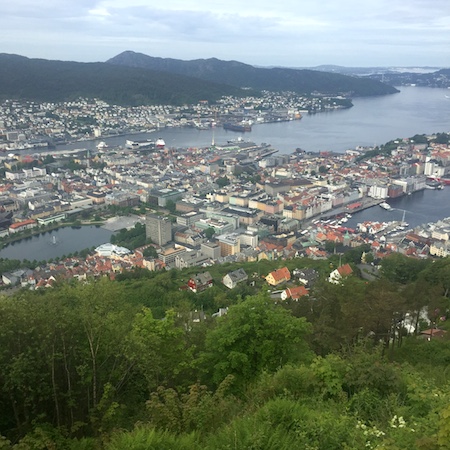
Bergen is a lovely town of about 200,000 people on the coast of Norway. It’s the second biggest city (after Oslo), and we had a great time exploring it.
Funicular
There’s a funicular that takes you to the top of the surrounding hills. There are tons of hiking trails across these hills – we saw at least two big groups of people with packs on getting ready for a multi-day hike. There’s also a restaurant and gift shop at the top. So you can go up for an hour or two as well.
There’s also a troll garden at the top of the funicular, hidden in the forest. This hipster troll is the one who greets you at the entrance. (You can see other trolls in the background.)
Sometimes, the trolls are hiding. (This one feels very Wallace & Gromit-y to me. I think it’s the hands.)
Hanseatic League Remember your history lessons, where you learned that the Black Plague killed 1/3 of the European population? Well, the disease had a 50% fatality rate in Norway and 80% in Bergen. That’s right, after the Black Plague came through, only 20% of Bergen was left standing. That’s when the Hanseatic League came in to take over the business side of things.
This is a dried stockfish. I was told they keep forever, and to eat them, you just need to soak it in water for 24 hours. This is what the Hansa were trading.
We took a tour of the Hanseatic Museum – this is one of the teapots.
This is a view across the harbor to the Hansa buildings. We were grabbing lunch and plotting out our afternoon. Note that the outdoor seating in Norwegian restaurants comes with blankets.
City Center
Bergen isn’t big, but we did leave the harbor for a bit to walk around the city center. There’s a nice pedestrian shopping district (I bought a sweater from Moods of Norway) and some lovely buildings from the 1800s-ish.
A statue of Edward Grieg. He’s from Bergen and they’re very proud of him. If we’d had another day, we’d’ve gone to his house (it’s a museum now).
A gazebo in a park. I don’t remember much about it, except for the fact that I thought it was pretty.
This isn’t anyone in particular, just a violinist looking very intense. His intensity is mitigated by the tranquil sounds of the water.
Just beyond the previous statue, there’s a lovely boulevard leading to some governmental building.
Old Town Then it was time to head back. We went back through the old part of the town, exploring some of the twistier streets.
My husband and daughter walking down one of the wider old twisty streets.
My feet and shopping bag along with an interesting manhole cover.
More old Hansa buildings. Fun fact: because the Norwegians always built with wood, they had a fire problem. After a big fire, they’d dump all the burnt wood into the harbor and then build the new houses on the landfill. Then the landfill would settle. These might have been built straight, but they aren’t anymore.
Doesn’t every building need a golden stag head?
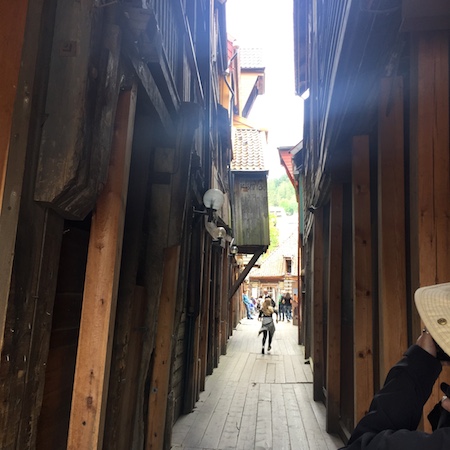
An alleyway between some of those buildings. Right angles, schmight angles.
After you go down the alleyway, it opens up into a little courtyard full of cafes and giftshops. I imagine that ladder was important back in the day before this was the tourist section of town. Was that the front door?
I didn’t manage to get any good photos of Rosenkrantz Tower or Hakonshall – the two big medieval buildings in Bergen. But they did have this lovely little minimalist cafe where I had a cup of tea and my daughter had a frozen snickers bar. (Ice cream is HUGE in Norway. HUGE. It felt a little like being back in Wisconsin – where I grew up – but with more ice cream shops.)
If you’re spending time in Scandinavia, I’d definitely recommend a day or two in Bergen if you can fit it in.
We visited the Ny Carlsberg Glyptotek, an art museum founded by a Carlsberg of the brewing family, while we were in Copenhagen. I wanted to go because it has a famous bust of Pompey; it turned out that we showed up on free admission day. Yay! (We splurged and ate lunch at the museum, an always expensive proposition. It compensated for not paying admission.)
It’s got a good collection of antiquities. I’m always (of course) most interested in anything Ancient Rome, but there was also a handful of artwork from the 1800s. It’s a lovely museum, worth a few hours of your time.
Atrium
You enter the museum (after you buy your ticket) through a central atrium. It was a bright day in Copenhagen, this room was not air conditioned. (It’s clearly not normally that sunny; it was hot.)
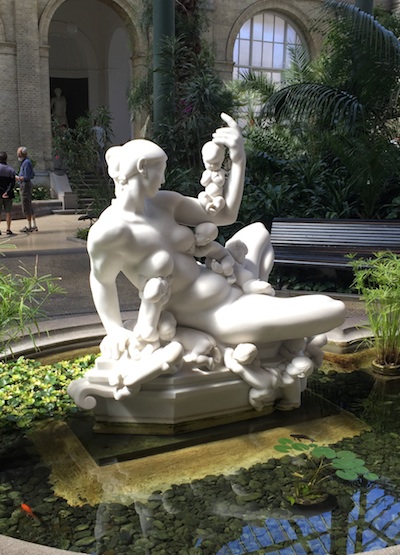
The central statue in the atrium. It’s both impressive and disturbing. I can’t image that many babies needing my attention all at once.
I enjoy this little hippo statue hidden amongst the foliage. It’s cute.
Non-bust antiquities
There are a lot of heads on pillars (aka busts) in the Glyptotek. LOTS. These are a few antiquities that aren’t busts.
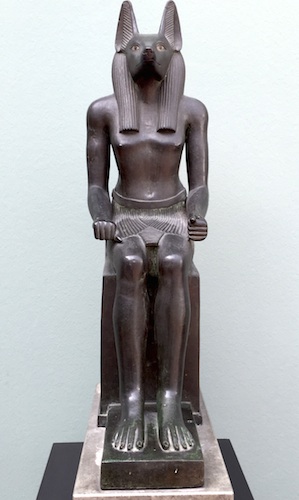
I’m pretty sure this is Anubis – the Egyptian god of the dead. But don’t quote me on that.
Hieroglyphics that, I think, tell the story of an animal sacrifice. (I should really record what these photos are of when I take them.)
The Roman Emperor Nerva. He succeeded Domitian (who the Senate really, REALLY hated – he had a bad reputation for centuries) and was the first of the five Good Emperors.
Ancient Heads
You turn the corner and look into this room and it’s, quite frankly, a little disturbing. I definitely did a double take.
Pompey the Great, sporting Alexander the Great’s hairstyle. (All the ancient generals wanted to be Alexander – to the point of copying the way he did his hair.) This one is famous.
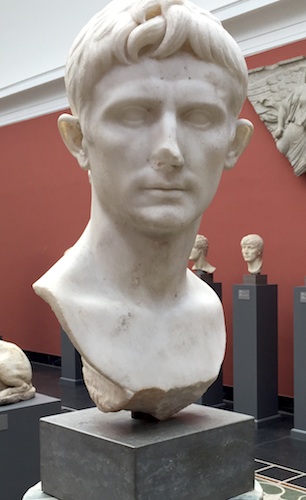
Augustus, Ancient Rome’s very first emperor. He looks like an awkward, if determined, young man to me, here, with his ears sticking out.
Livia, Augustus’ wife. She was probably not as evil as Robert Graves’ I, Claudius wants you to think she was.
Septemius Severus. He had a reputation of being a hard-ass, but he was also putting the empire back together after 100 years of mis-management. He needed to be a hard-ass.
Like I said earlier, there was also some art from the late 1800s, both French and Danish – lots of early Gaugin, actually – but this post is long enough as it is and the majority of the art in the Glyptotek is of the ancient variety. It’s a nice little collection.
We took a vacation! A big one, too. We spent a little more than two weeks in Scandinavia. I’d never been to Denmark, Norway, or Sweden before, and we managed to hit all three.*
I’m going to be spreading out the photos over the next couple of weeks in a series of posts, so stay tuned if there’s a particular destination/sight you’re interested in.
Today
We spent a total of about three days in Copenhagen, much of it just walking around the city. Urban hiking is the best.
Statues
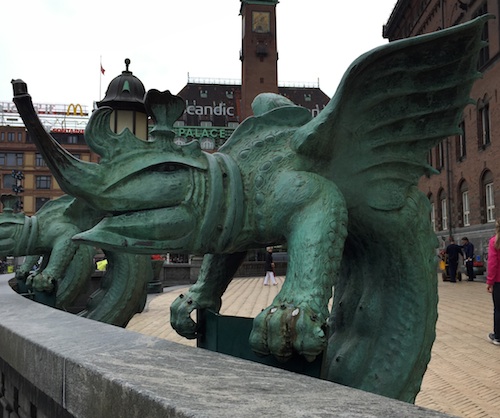
There are a row of these on the balustrade outside Copenhagen’s city hall. I have no idea what animal this is. Dragon? Elephant? Serpent? Some combo of the three? (FWIW, there are lions on the city’s coat of arms. This isn’t a lion.)
The Little Mermaid, possibly the most famous statue in Copenhagen. Everyone tells you that you’re going to be disappointed when you see it – it’s smaller than you think. Hans Christian Andersen is Danish, and they’re very proud of him.
A statue in a park not too far from The Little Mermaid. I’m not sure who it is or what it’s of, but I do enjoy how much random artwork there is on the streets in Europe.
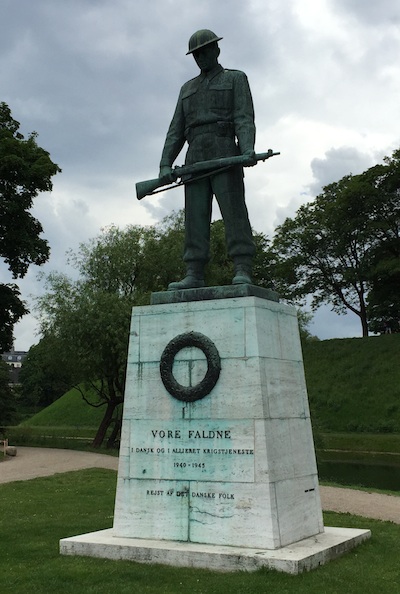
The World War II memorial. Possibly the unknown solider memorial?
Nyhaven
This is the bit of Copenhagen that’s on all the postcards. It’s like the Eiffel Tower in Paris: it’s the most touristy thing ever, but you have to go.
This boat has its own lighthouse. Nyhaven is a harbor (I *think* haven (Danish) = harbor (English); there are tons of boats. I also like the rust red of the boat with the dark blue of that house in the background.
Not the actual harbor. This was in the Copenhagen Lego store. (Remember kids, Lego is a Danish company.)
We saw this style of architecture – colorful row houses next to a harbor – all through Scandinavia. It’s what Scandinavian design used to mean before it was all clean lines and white and minimalist.
Buildings
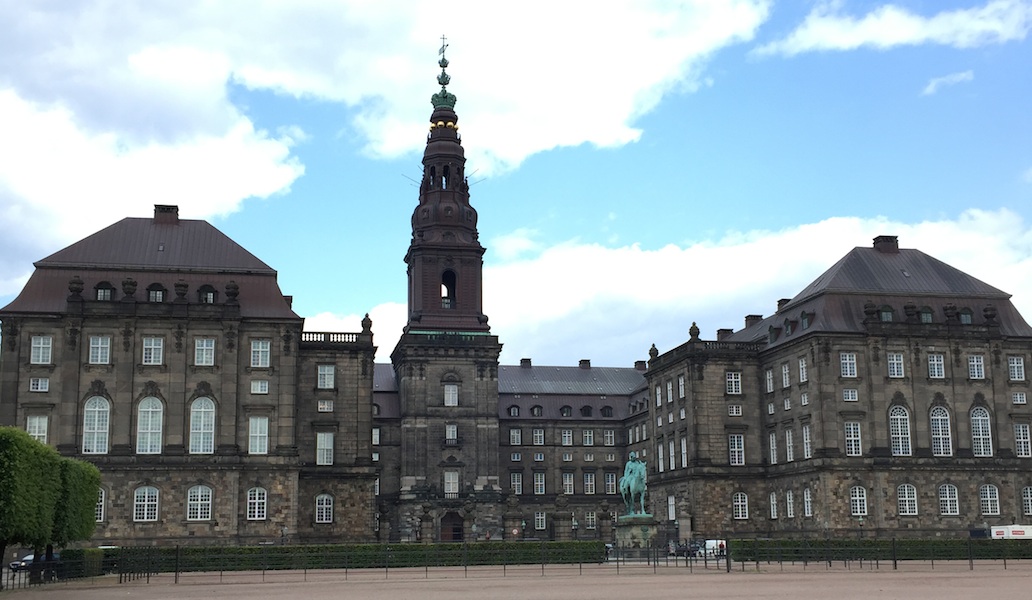
It wouldn’t be a European city without a palace or two. This is the Christiansborg Palace; the Danish royal family uses the Amalieanborg Palace. This one has a lot of official government offices.
It also wouldn’t be a European city without a church or three. This was a lovely church near The Little Mermaid statue. I tried to get arty by putting the fountain in the foreground. I’m not sure it worked.
We’ve covered palaces and churches…. Can I interest you in a museum? This one’s the Copenhagen Jewish Museum. We didn’t go in, I just liked the building.
This crooked photo (seriously self, learn to hold the camera level) is the new Copenhagen Opera House. It’s on the main canal/river through town. If you’re thinking it looks like a giant diving platform, well, you’re not the only one. Red Bull hosted a diving competition off the roof the weekend before we were there.
And this building is the entrance to the Tivoli Gardens amusement park, which includes the highest swing ride I have ever seen. To quote my husband, “That’s high enough to make you calculate the tensile strength of those cables.” Yes, I married an engineer.
Gardens and Flowers
I was surprised through the whole trip to see an amazing number of flowers. My kid (who lives in drought-riddled California) couldn’t get over how green everything was. It made me remember how much you enjoy nature when it’s cold and white and grey for winter.
This is the garden/park across the street from the Amalieanborg Palace. It’s also across the canal/river from the Opera House. It’s a lovely pale and there were lots of locals eating lunch on its benches and low walls.
This is on Hans Christian Andersen Blvd. Permanent flowerbeds on the streets. I also like that you can see the omni-present bike lanes. (We were taking a tour bus to the port for the next stage of our trip and an older American woman couldn’t stop exclaiming [loudly, sigh] over how many bikes there were in the city. “I could never live here, I can’t ride a bike!”)I don’t remember which park this was, and I’ve no idea what that building is – but I’m pretty sure it’s offices or apartments or shops. Nothing remarkable. This one’s just pretty.
Random leftovers
These are a couple of photos that don’t really fit into categories, but I couldn’t bring myself to leave them out.
Herring for breakfast is a thing in Copenhagen. Fish is everywhere, as you might expect. (So are pickled vegetables and the food was more salted than I was used to.) An acquaintance of mine is married to a Danish man. She claims to enjoy the curry herring. I couldn’t work up my nerve to try it at 8am.
This was the fanciest light pole I’d seen in awhile. It’s got a date on it from 1676, but the lights in it are fluorescent.
Did I mention that we did a lot of walking? And we only stayed in the center (largely). I’d’ve loved to explore more. Next time!
* I should tell you: I don’t enjoy the if-this-is-Tuesday-it-must-be-Belguim cramming in of sights and stops. I would have loved to spend way more time in each city/country. Nonetheless, we got a decent overview of each place. I think. Next time, in depth!