Adulting

The One and Only

What’s it about?
Shea Walker loves football. LOVES it. She lives in small-town Texas, where she grew up, best friends with the college football coach’s daughter, Lucy. When Lucy’s mother dies (right at the beginning of the book) Shea starts to look at her easy life. She gets kicks in the pants along the way from her loving family and friends, too. It’s not just her.

Why should you read it? 
Emily Giffin writes books that take a romantic structure (Shea has three different boyfriends through the novel) and turns it into the protagonist figuring out who she is. It’s a thing that’s shared with some of the better YA books, even though the main character in this one is 33. She’s living in an extended adolescence – it’s time for her to grow up. The One and Only is Shea figuring out how to grow up, and who she is as an adult.

Love and understanding

far from the tree

What’s it about?
Far from the Tree is, to summarize, about parenting difficult/different children. The author posits a construction. Vertical identity is the culture you get from your parents; horizontal identity is the culture you get from the world around you. But what happens when your child has a drastically different horizontal identity? Each chapter looks at family units who are dealing with a radically different horizontal identity: deaf children born to hearing parents; autistic children; prodigies; children who choose lives of crime; there are more. It’s a sympathetic look at how parents and children navigate figuring out who they are as individuals and who they are in relation to each other and the outside world.

Why should you read it?
It is long (700 pages). You should read Far from the Tree if you have children or want children. It’s not going to give you parenting tips, unless you want to be hammered over the head with “your child needs to feel safe and secure and loved so DO THAT” and “find meaning in your parenting to be happy.” These are lessons so global as to be almost useless. But it does help you understand differences in the world – all the examples about Deaf culture or how the world treats transgendered kids illustrate that everyone does have the same basic needs: to be loved and accepted. (I did skip most of the chapter on kids conceived in rape. I couldn’t deal with 50-60 pages continually recounting women at their most vulnerable.)

Overall, a thorough book that’s worth your time.

Real world? What real world?

The Rosie Project


What’s it about?
The Rosie Project is a cute little beach read about a professor with Aspberger’s syndrome and his hunt for a mate. It’s told from his point of view; Rosie is a PhD student he crosses paths with. He starts to help with her project, and ends up having fun.

Why should you read it? 
You should read The Rosie Project on vacation somewhere, as a further distraction from the real world. It’s not going to change your life, but it will entertain you for a few hours. Sometimes, that’s exactly what you need. You can also admire the fact that it’s written with an autistic person as the main character – something you don’t find every day. (Diversity in fiction is important!)

All science, no philosophy

the remains of the day


What’s it about?
The movie version of The Remains of the Day is an elegant but sad love story between the butler and the housekeeper of an English estate between WWI and WWII. The butler’s uncompromising standards and obsession with his work doom their romantic relationship. The book version is an entirely different story. The attraction is still there, but it is secondary to the main plot. That story is about how the butler’s uncompromising standards and obsession with his work make him unable to hold his own opinions about literally anything else. Between the wars, some British, including the butler’s employer, Lord Darlingon, were trying to appease the Nazis. All the butler is able to do is go about his work. In this case, there is a conference between the Germans and the Brits in the house; it ends badly.

Why should you read it?
See, now this is a book about an awful yet sympathetic person that was a delight to read. Kazuo Ishiguro writes divinely, you sympathize with the butler who wants to do his job as best he can, and you see the German-British relationship for the tragedy it was. You might even mourn the end of the British Empire. While the book was entirely different than what I expected, I still enjoyed it.

Kim Gordon is cooler than you

Girl in a Band


What’s it about?
Girl in a Band is about Kim Gordon’s life. Who’s Kim Gordon? She was the bassist for Sonic Youth, but the book doesn’t talk a huge amount about Sonic Youth. It’s about her childhood in Los Angeles; her years as a visual artist in 1980s NYC; it covers a bit about her marriage and the band and how some of the main albums were created.

Why should you read it?
Because Kim Gordon has her shit together. She is cooler than you because she has lived and spent time figuring things out: what kind of artist she wanted to be, what kind of parent she wanted to be, what was best for her. Reflecting on the book, I also think writing this might have been a way for her to define herself outside Sonic Youth and her marriage (since she is recently divorced). Who is Kim Gordon if she isn’t Sonic Youth? To clarify: the first draft might have been uncertain. The version that I read wasn’t. She has a clear sense of who she is and what she thinks and she is communicating that to you.

I want to be Kim Gordon. At least a little bit.

Spoilers, sweetie

A God in Ruins

What’s it about?
A God in Ruins is a kind-of sequel to Life After Life. If you’ve read Life After Life, you might wonder how a follow-up could be possible. Before I read the book, my hypothesis was that she’d just chosen one of Ursula’s lives and gone with it. (However, my inability to remember what, exactly, happened to Teddy by the end of Life After Life was frustrating.) This book is about Teddy, Ursula’s younger brother. It’s a profile of his life, his wife’s, and their awful daughter. There are two grandchildren as well; they turn out ok. These are not spoilers – the book isn’t told in chronological order. In fact, there was a point towards the end of the book where I was wondering how on earth the grandchildren ended up as healthy as they were.

Why should you read it? 
Because Kate Atkinson is a good author. This is a wonderful story; it’s about so many things. Themes of nature and how the world changes in the 20th Century, personal choice, and how we think about our lives and the people in them. I would definitely recommend A God in Ruins to anyone who liked Life After Life.

Media Studies in the Ancient World

Confronting the Classics by Mary Beard

What’s it about?
Confronting the Classics is a series of book reviews written for the London Review of Books, the New York Review of Books, or the Times Literary Supplement over the years by the author. Mary Beard is a famous classicist (if there is such a thing as a famous classicist), and her reviews are all trying to answer the question: why does this particular book she’s reviewing matter to you, a non-classicist?

Why should you read it?
I loved it for a few reasons.

  1. I have a not-so-secret fondness for Ancient Rome. Mary Beard has a great skeptical eye through which to take a second look at some books I’ve read.
  2. Not to mention suggestions for all kinds of new books to read. Seriously, this one made my to-read list grow.
  3. She asks the serious question: why is Asterix so funny? Why do so many people (including me) love Asterix?
  4. I like her approach to book reviewing – asking why a particular book matters to someone who isn’t a classicist allows her to explore all kinds of questions. What was the woman’s voice in Ancient Greece (about Sappho)? What did the ancients find funny? Why do we still find most of those jokes funny?
  5. So much of what we know about the ancient world is because of what’s been written down. That’s biased in certain ways, with certain people wanting to influence how someone else was perceived. (e.g. Augustus burning anything about Cleopatra that didn’t fit how he wanted Roman society to see her). She takes a critical eye that reminded me a lot of modern media studies – there’s a thread in common with, say, Anne Helen Petersen.

Overall, I enjoyed it. You might too.

Love and affection

I Capture the Castle
This was a well-loved library book. It had been read so much that the pages were soft and the corners had been worn off. It was amazing.

What’s it about?
I first heard of I Capture the Castle on the boards of the Go Fug Yourself book club, where it was described as “people having romantical problems during wartime.” It was published in 1948. It’s about a poor family, the Mortmains, living on not very much in an old castle that they’d secured a long-term lease on back when their father’s famous book was still paying the bills. An elderly, wealthy neighbor dies and his heirs are wealthy American half-brothers. The older sister, Rose, immediately sees that marrying one of them would keep the family from starving and convinces herself that she’s in love with him. It… it doesn’t work out so well.

Why should you read it?
It’s so old that it’s lack of an automatic happy ending (spoiler) is refreshing. (It’s not that the ending is unhappy. But it’s not a standard Hollywood ending either.) The Mortmains are charming and artistic, living the Bohemian lifestyle that you’d expect from poor artists: the father is a writer, as is Cassandra – the younger sister who’s POV the story is written from – Topaz, the step-mother and former model/current painter. Rose is the one who wants to not worry about where their next meal is coming from all the time. Ms Smith’s love of the English countryside also comes through loud and clear – the setting is amazing and lovingly described.

Overall, there’s so much affection in this book for the place and the characters and the impossible situation they’re in – really, where *is* their next meal going to come from – that you can’t help but also enjoy it. (In fact it’s a bit odd, because the book contrasts affection and love so very well. But the book’s love and affection of everything and everyone in it is what makes it so wonderful. Hm.)

A sci-fi classic (in my world, anyway)

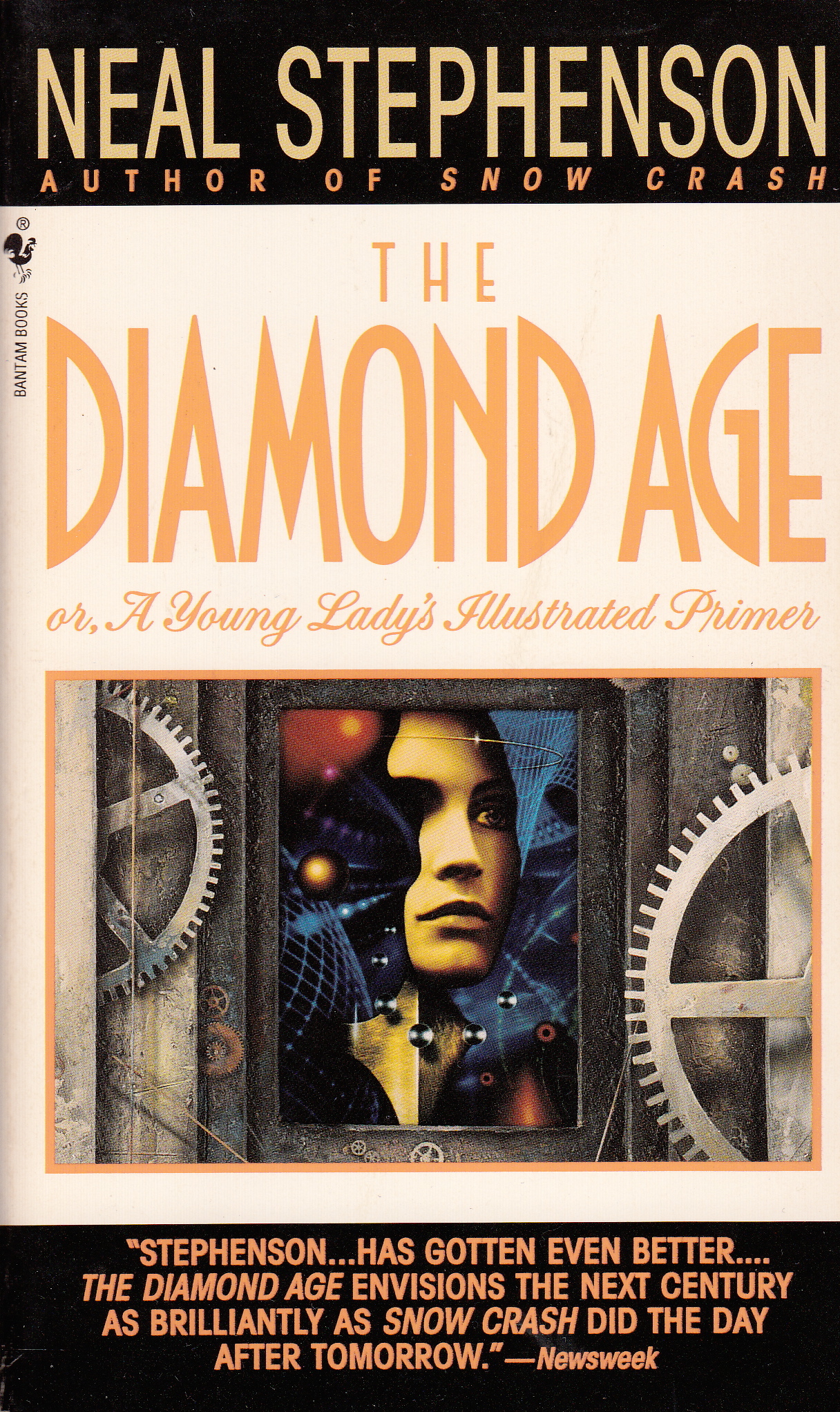
the diamond age

What’s it about?
The Diamond Age is a classic from 1996 (that feels so wrong to type – I was in college, for chrissakes). It’s a story about the future and a special kind of book – an electronic book before there were kindles or nooks or iPads. This is a book that helps a child learn. It’s personalized to the child – figuring out what they know about both academics and the world around them. It teaches these children how to function in the world, and the goal is not just to make them book smart, but also to give them the drive and the ability to succeed as things change. And not just react to that change, but create the change. Three bespoke versions of the book are made: one for a wealthy man’s granddaughter, one for the inventor’s daughter, and one that gets lost and ends up in the hands of a street urchin named Nell. They change the world.

Why should you read it? 
Disclaimer: The Diamond Age has been my favorite Neal Stephenson book since I first read it. I may have read Snow Crash first, but I like this one more.

Why? There’s the obvious: I’m female and I love reading. I’m generally tech-optimistic, even if I have doubts about our current technology. A sci-fi book about education and reading with women in primary roles? Sign me up.

But I also love it because of the world it creates. The characterization of China was off – Stephenson missed China’s meteoric rise over the last 20 years – but the Vickys (the neo-Victorians) and the other various sects play well together. And I can see a neo-Victorian strain in Silicon Valley, with its insistence on perfectibility – if we could only do x or figure out y, then we could make everything perfect!

It is a classic. Read it if you haven’t.

Beach read, not chick lit

Mr Penumbra's 24-hour Bookstore


What’s it about?
Mr Penumbra’s 24-Hour Bookstore is about a secret society that is trying to solve an algorithm without a computer. What happens when you bring a computer to bear on the problem? In fact, given that this story takes place in San Francisco and near Silicon Valley, what happens when you let Google’s geniuses and computing power at the problem? Well, this book tries to answer that, all while commenting on life in the SF Bay Area.

Why should you read it?
It’s not a great book. I read it for book club; the more we tried to analyze it, the more we realized its flaws. It’s not Great Literature, but it did manage to keep the mystery going long enough to be entertaining. Not to mention, it did a decent job of having fun with Silicon Valley stereotypes. Sometimes, that’s exactly what you want.