Part of a bigger world

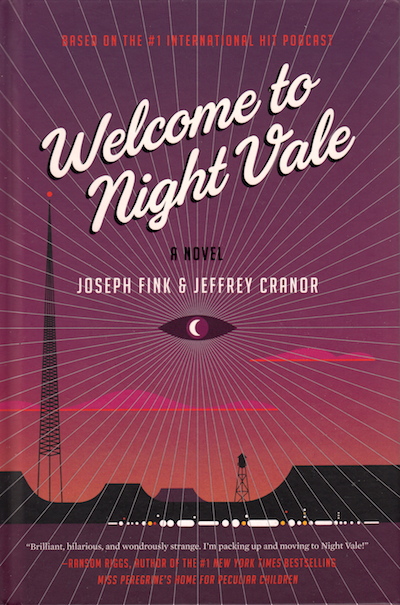
Welcome to Night Vale

What’s it about?
Do you listen to Welcome to Night Vale? If you like slightly weird things, you should. It’s a touch on the horror side of things (there’s a faceless old woman who secretly lives in your house), and it’s deeply entertaining.

If you’ve heard the podcast, you know that sometimes there’s a man in a tan jacket who no one remembers after they’re done talking to him. This book? This book is his story.

Why should you read it?
You should read Welcome to Night Vale if you’re a fan of the podcast. There’s obviously less Cecil (the voice of WtNV) as there’s no talking, but there are interludes of Night Vale Community Radio. I wouldn’t read it if you’re not a fan of the podcast already – there’s a fair bit it presumes you already know.

But it is an entertaining entry in the world of Night Vale, and explains a bit more about the rules of Night Vale, things that the radio show only hints at.

Strong Women and Magical Realism

State of Wonder by Ann Patchett

What’s it about?
State of Wonder is about a not-young-anymore doctor/pharmaceutical researcher, Dr Marina Singh, whose colleague (Dr Anders Eckman) has gone to the Amazonian rain forest and then died. He’d gone to the Amazon in search of yet another colleague researching a new fertility drug, Dr Anneck Swenson. Dr Swenson’s letter home informing them of his death was on the terse side. Dr Singh has many adventures in her quest to find out what, exactly, happened.

Why should you read it?
Well, you should read it because everyone loves a good quest story. What’s Dr Singh’s stated goal? To find out what happened to Dr Eckman, and what’s going on with Dr Swenson. What’s her actual goal? To get over a traumatic birth where she was the doctor performing an emergency c-section twenty years before.

I enjoyed the relationships between the characters and the strong women and their complexity as people. The men are around, but the women are the main focus. And the city of Manaus, Brazil; it sounds both boring and complex and interesting – her descriptions of it help shape the story.

Also, be aware that this one veers into magical realism a few times. There was a point where I was waiting for the book to reveal that it was all a fever dream brought on by an antimalarial drug. It wasn’t.

I wouldn’t have read this one if it hadn’t been for book club. I’m happy I did.

Making a life for onesself

The Language of Flowers

What’s it about?
Victoria is a mess. She’s grown up in the foster care system, and she’s just turned 18, which means that there’s no one responsible for her any more. And she certainly hasn’t mastered the basics of finding food and shelter, let alone having a life. But she does like flowers and what they mean. This is the story of how she pieces a life together.

Why should you read it?
You’ll need to make it past the first chapter of The Language of Flowers, which I found slightly cringe-worthy. Maybe I was supposed to – after all, she isn’t a good person at first and her life is pretty terrible. There’s not a lot to like there.

But after that, once you get into her relationships with other people, with her desire to be a florist, with her relationships with Grant and Elizabeth and the family she’s fallen into in San Francisco, it’s good. I like a story where someone turns their life around, and not into a typical life. You can be successful without being a stereotype.

Physics and Gender Studies

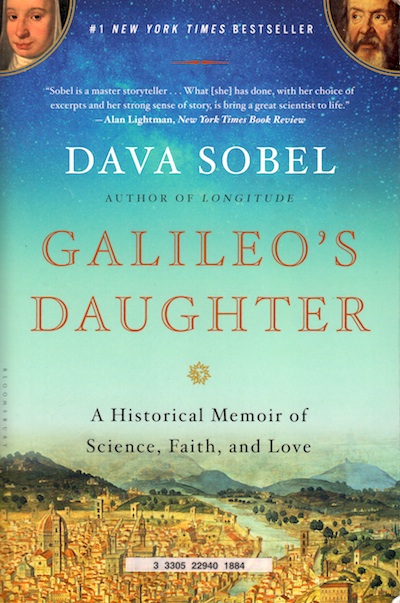
Galileo's Daughter

What’s it about?
Galileo Galilei was, in many ways, the founding father of modern science. He was one of the first people to insist that you needed to both know theory and experiment to confirm that theory. He, famously, refined and popularized the telescope and wrote a treatise on motion that inspired Newton.

He also had a daughter. Two daughters, actually. But her half of correspondence with the eldest lives and frames this biography of Galileo as a father with responsibilities to his family as well as tells the story of his struggles with the Catholic Church.

Why should you read it?
You should read Galileo’s Daughter because it humanizes the scientist and goes into detail about his conflicts with the Church. Which I only knew some of, honestly. It’s a solidly written biography of an interesting person during an interesting historical era.

It also, if you choose to look at it that way, highlights the different ways men and women behaved in Reform-era Italy. Galileo was brilliant and was allowed to be kind of a cad when he was young – fathering three children without marrying their mother. He is defined by his science and the whole religion-science debate.

Maria Celeste had to become a nun because her mother died and Galileo couldn’t raise her on his own. She was intelligent and hyper-competent; she clearly loved and supported her father. Today, she might have been a famous scientist. In 1600s Tuscany, she was a supportive family member and near-abbess. It’s a pity, really, that she wasn’t allowed to flourish as a scientist. I bet she’d’ve been great at it.

People and food and immigration

Book of Unknown Americans

What’s it about?
It’s 2007 or early 2008, and Arturo, Alma, and Maribel Rivera have left Mexico to live in Delaware. Maribel had been in an accident a year or so earlier, and she needs to go to a special school. Alma finds that the best place is in Delaware. So they leave their village where they’ve lived all their lives, Arturo has found a job and a company who will sponsor him, all for the betterment of Maribel. They live in a run-down apartment building, full of other Hispanic immigrants. The Book of Unknown Americans is about the Riveras and their neighbors as they live their lives. There is a plot – Mayor is the boy next door who likes Maribel, and there is a bully at school; the market crash happens in 2008 and Arturo loses his job – but it’s mostly about making you see individuals.

Why should you read it?
It’s a lovely little book full of touching vignettes. And it made me SO HUNGRY. All that delicious food described – so much of how people are doing in this story is shown through what they are eating.

But also it’s about reading/telling stories that we don’t often see: poor people, immigrants, working class, brown skin. It’s about showing what’s universal – we all love food and we all love our families and we all work our butts off. Sometimes that breeds more success than others. If you have a few hours, it’s worth it.

Funny Women are Funny

yes please

What’s it about? 
Yes Please is Amy Poehler’s memoir. She is a workaholic of a person, but she loves it. She is also funny and warm and this made me want to watch Parks & Recreation. (I had a small child when it aired. I wasn’t watching anything at that point.)

Why should you read it?
It’s another entry in the smart, funny women memoirs that I like to think of as a series: Bossypants, Is Everyone Hanging Out Without Me, Yes Please. These are great books for a teenaged girl (or an adult woman!) to read because these women are amazing role models. Plus, it made me laugh. What more could I ask for?

A Surprising Beach Read

A Paris Affair

What’s is about?
A Paris Affair is a set of short stories about couples, mostly in their thirties, many with young children, who are on their way to breaking up because one or the other is having an affair.

Why should you read it?
It’s a lovely little slip of a book. It made a great back-from-vacation read last month; my brain always lingers in Europe and who doesn’t enjoy Paris? Examining the ways a relationship can go south can be as interesting as how two people get together. It’s not heavy, but who cares? I would classify this one as a sophisticated beach read.

Putting the world in order

Maisie Dobbs: A Lesson in Secrets


What’s it about?
Maisie Dobbs is an independent woman in 1930s London. She is a private investigator, which lends itself well to a mystery series. This is the eighth book in the series; pro-fascist groups are on the rise in London (and Britain in general). Maisie is hired by a national security organization to keep an eye on a private college in Oxford that emphasizes peace in all its teachings. Not because they want to avoid war, but because the security services are worried the pro-fascist factions have infiltrated it. She is supposed to do some light investigating and keep the right people apprised of what she discovers. Of course, the college’s head is murdered and Maisie needs to figure out who did it.

Why should you read it?
A Lesson in Secrets is the first in the series that I’d read; that was a mistake. There are a number of characters and a couple of ongoing plots that were hard to keep track of simply because I wasn’t familiar with the previous seven books. That said, I liked the tone and crisp efficiency of the book and the main character. These are People Who Get Things Done. I think that’s what mysteries are ultimately about: taking a messy situation and putting it in order. This one fills its mission well, and I do love a bit of 1930s London & Oxford. I will definitely go back and read the previous books.

Adventure story

Ready Player One

What’s it about?
There was once a man named James Halliday. He liked D&D, then he learned to code, and he and his best friend Ogden started a video game company. They eventually created an immersive VR called Oasis – a place to escape the real world. The real world kind of sucked, so everyone and everything moved into Oasis. James and Ogden became multi-billionaires. Eventually, James dies and starts a game (via his last will & testament) to find an easter egg that he left behind. The first person to find the easter egg will be his will’s beneficiary – they will get all his stuff and all his money. Including his half of the video game company. Parzival – the main character of the book – wants to win. So do a lot of other people.

Why should you read it?
There’s a lot to like about Ready Player One: the constant homage to 80s culture, the quest (I love a good quest), the dystopia that you can totally understand how we got there.* I like that it explores ideas about how slipping into a digital world removes you from the physical world. I do find the idea that life is a game to be won a bit disturbing – winning the quest means money and power. To get all hippy-y, life is necessarily about the journey – it’s about where you go and who you meet and some of what you do, but it’s not about amassing wealth and power. That’s in the book somewhat.

But overall, it’s a fun adventure that was a good story to read on vacation.


* As much as I enjoy Hunger Games, I do not understand how the US gets into a place where that society functions. It seems inherently unstable.

Charmed, I’m sure

The Royal We

Embarassingly, I read The Royal We more than two months ago. I would have sworn that I wrote a post about it. But looking through my drafts and posts… it never made it out of the (very) rough draft stage. So here it is, much later than it should be.

What’s it about?
Bex is going to Oxford to study art. She lands in a suite that includes Nick, the future King of Great Britain. There are some shenanigans, but they fall in love. This is where the story really starts: Bex (a girl from Iowa) learns what it’s like to be in a relationship with someone whose entire life is – and will always be – in the center of a media scrum. What is it like to go from being a fairly laid-back person to not being able to make a move without it being scrutinized? How would it change you? Could you have a normal relationship? What would your life be like? Most importantly, what would you wear?

Why should you read it?
You should read The Royal We because it’s totally adorable. Nick and Bex are a very cute couple (his characterization falls off a bit towards the end); the supporting characters are largely fully realized people; I believe that these are the reactions of normal people put into very weird circumstances. It’s no secret that the story is inspired by the whole Wills-and-Kate relationship; in fact, you could read this as extended fan fiction of the British monarchy. But that’s ok – it’s so charming and lovely (I read it in one sitting, practically) that it’s worth your time.