Acknowledging a transition

the bar mitzvah and the beast


What’s it about?
The Bar Mitzvah and the Beast is about an SF Bay Area family that bikes across the country. Why? Well, the father is Jewish and his turning-13-year-old son is an atheist. The father (Matt, also the author) wants to mark his son’s passage into his teenage years; the son tries to go to Hebrew school and have a Bar Mitzvah, but just can’t. So a cross-country bike ride is their compromise. They spend a summer riding from San Francisco to Washington DC. The whole family goes – Matt, his wife, Yonah (the son), and his little brother. (The Beast is an old tandem bike that they buy for Matt & the little brother to ride across the country.)

Why should you read it?
I am not religious (to my mind, you can’t prove either the existence or non-existence of god and I don’t worry about it that much), so I sympathized with Yonah. But I did like the idea of commemorating your child’s passage into their teenage years. My daughter is eleven and as she moves from her childhood to being a teenager, she is changing. Acknowledging that somehow, formally or informally, seems worthwhile. I’d never really thought about that before reading The Bar Mitzvah and the Beast.

The book was strongest when it was talking about Yonah’s rite of passage. It also wanted to be about overcoming your prejudices and drawing awareness to global warming. The marriage of the three themes wasn’t successful to my mind. But it’s still worthwhile.

Light and Dark

All the Light We Cannot See


What’s it about?
There are two main plot threads in All the Light We Cannot See. In the first, there’s a blind girl (Marie-Laure) living with her father (Monsieur LeBlanc) in Paris in the 1930s. The main things to know about them are: she’s smart, he’s a key master who is also great at building puzzle boxes. World War II comes, and they end up leaving Paris for Saint-Malo, a small bit of land that becomes an island at high tide. In the second, there’s an orphaned German boy (Werner) in the 1930s who builds radios. He loves building things in general and is entranced by radios in particular. He and his sister (Jutta) enjoy listening to a broadcast from France as children. He gets selected for a national school, run by the Nazis, because he is smart. He eventually gets sent to the front lines during WWII and ends up in Saint-Malo towards the end of the German occupation.

Why should you read it?
Well, in addition to being a National Book Awards Finalist and a NYTimes book of the year, All the Light We Cannot See also won a Pulitzer this week. So if you’re looking for an award-winning book, this one fits the bill nicely.

In addition to that, it is a gorgeously told story that made me get over my “really? heroes during WWII again?” skepticism. The characters are (mostly) richly created, the settings are amazing – you feel cold and wet when Werner is on the Russian front lines in WWII, and warm and loved when Marie-Laure is amongst her family in small town France. Really, it’s very well done.

This book is a brain worm

Station Eleven


What’s it about?
Station Eleven is three stories in one. It follows the lives of three people, before, during, and after a plague – the Georgia Flu – kills 99% of the people on earth. (Georgia the former Soviet Republic, not Georgia the state.) The pre-plague storyline follows an actor as he gets famous, and one of his wives. The during-the-plague story follows the paramedic who tries to save the actor who has a heart attack on stage the night the plague breaks out. The post-plague story follows the child actor who was on stage with the actor that night. It takes place 20 years after the Collapse (as it’s known in the book).

Why should you read it?
I can’t stop thinking about Station Eleven. I finished it almost a week ago, and the characters are with me. I think about Miranda, who wanted to be an artist; I think about Clark, with his museum; I think about the Frenchman stranded in Michigan starting a newspaper; I think about the lack of entertainment and information; I think about how tough Kirsten is; I think about Jeevan stockpiling food as fast as he can; I cannot stop thinking about becoming a survivalist – what if a flu came that killed people in 24 hours. How fast would it spread? Could I survive? What would life be like afterwards? How would we all react? There’s a scene where a person finds a group of people living in an airport. He starts crying, they ask him why. “Because I thought I was the only one.” It breaks my heart thinking about it. If I could give a copy of Station Eleven to everyone I know, I would. It’s that good.

What’s your purpose?

man's search for meaning


What’s it about?
Viktor Frankl spent World War II in a concentration camp. He was a therapist before he was imprisoned, and he used his time in the camps to better understand himself and humanity. It’s not a long overview of his time in the camps – maybe 100 pages? – but it’s powerful stuff. The upshot is that the people whose lives had meaning, who had something to live for, those people were the ones who survived. If you believed that you were going to be free by Christmas and then Christmas came and went, well, it was highly likely that you were going to die shortly thereafter. There’s a short appendix talking about his therapeutic philosophy – that everyone who believes their life has a purpose is happier and healthier. So why are you here?

Why should you read it?
The week I read this was a hard one. I was having a small bout of depression; my husband was out of town, so I was single-parenting; and I got insomnia. Reading Man’s Search for Meaning helped, a lot. It set my brain thinking about why I do what I do. I won’t go into detail (this blog post isn’t a therapy session!), but it gave me the headspace and strength to make it through. And I needed that. I know this book has helped other people figure out what they want to do with their lives. But for me it was simpler, more a confirmation that I’m ok with where I am. Sometimes, that’s all you need.

Relating to people

redeloyment


What’s it about?
Redeployment is a book of short stories written by a former marine. All the stories are, in some ways, about adjusting to civilian life after being stationed in Iraq. The men live spartan lives, and their emotional landscapes have completely changed. The men who weren’t in combat feel less worthy than those who were.

Why should you read it?
I read Redeployment right after The Empathy Exams, and the juxtaposition was interesting. Redeployment hits some of the same themes: trying to figure out what it means to be a person, particularly after you’ve been asked to do some heroic but mentally unhealthy things. How do you get back to personhood? How do other people see you? Are they empathetic? Why or why not? It’s a compelling read.

Networking is really about making friends

never eat alone


What’s it about?
Never Eat Alone is about having friends and their importance to your success. The book has some basic guidelines about how to be successful (set a three-year-out goal, create sub-goals that can be achieved every 1-3 months to keep yourself on track) and also how to meet people (hence the never eating alone because meals are a great time to get to know someone). Making and having friends is really how you get ahead in the world – the ambitious parents around here who insist their child get into this or that school often say, “It’s not that they’ll get a better education, it’s that their classmates will be the kids who are also successful.” It’s all about the networking in that case. But your friends will make reaching your goals easier, it won’t magically transport you to a place where all your goals are met.

Why should you read it?
I liked it because of its project-based approach to achieving your goals, and how the book emphasized that you have to work hard in order to get ahead. Networking is part of it – it helps to know the right people – but networking in this case means making friends. It’s not some weird business-only relationship. This book is full of advice about meeting people and being open to new people and being generous towards them. That was refreshing. I did skip the bits of the book that were more about “the brand of you” – creating an online persona that reflects what you want people to know about you rather than what you’re really about. That was all eyeroll-worthy. But overall, there are enough good parts of the book that it’s worth reading.

Thoughtful feeling

the empathy exams


What’s it about?
The Empathy Exams is a series of personal essays – if they were strung into one, this would be a memoir. The first one is titled The Empathy Exams, and it’s about her job at a medical school. She’s required to portray different patients with different ailments and symptoms and willingnesses to talk about those symptoms. The medical students are required to talk to her to gather information to diagnose her, but also to improve their bedside manner. After the interviews, she has to grade them on, among other things, their empathy. Did the students make her feel like they felt her pain? She also gains a lot of insight into what empathy is. The rest of the essays in the book are about her putting herself into situations (or situations she’s already been in) and empathizing with the people around her. What can she learn about humanity?

Why should you read it?
Because learning about people and sympathizing with people is a good thing. Seriously, The Empathy Exams is an eloquent exploration of what it means to be a person. The author does a good job at making you feel her apprehension at getting an abortion. She communicates the horror of living in a world where drug lords are fighting for territory. But it’s never too heavy. It’s thoughtful. I enjoyed it.

Popular market research

what women want


What’s it about?
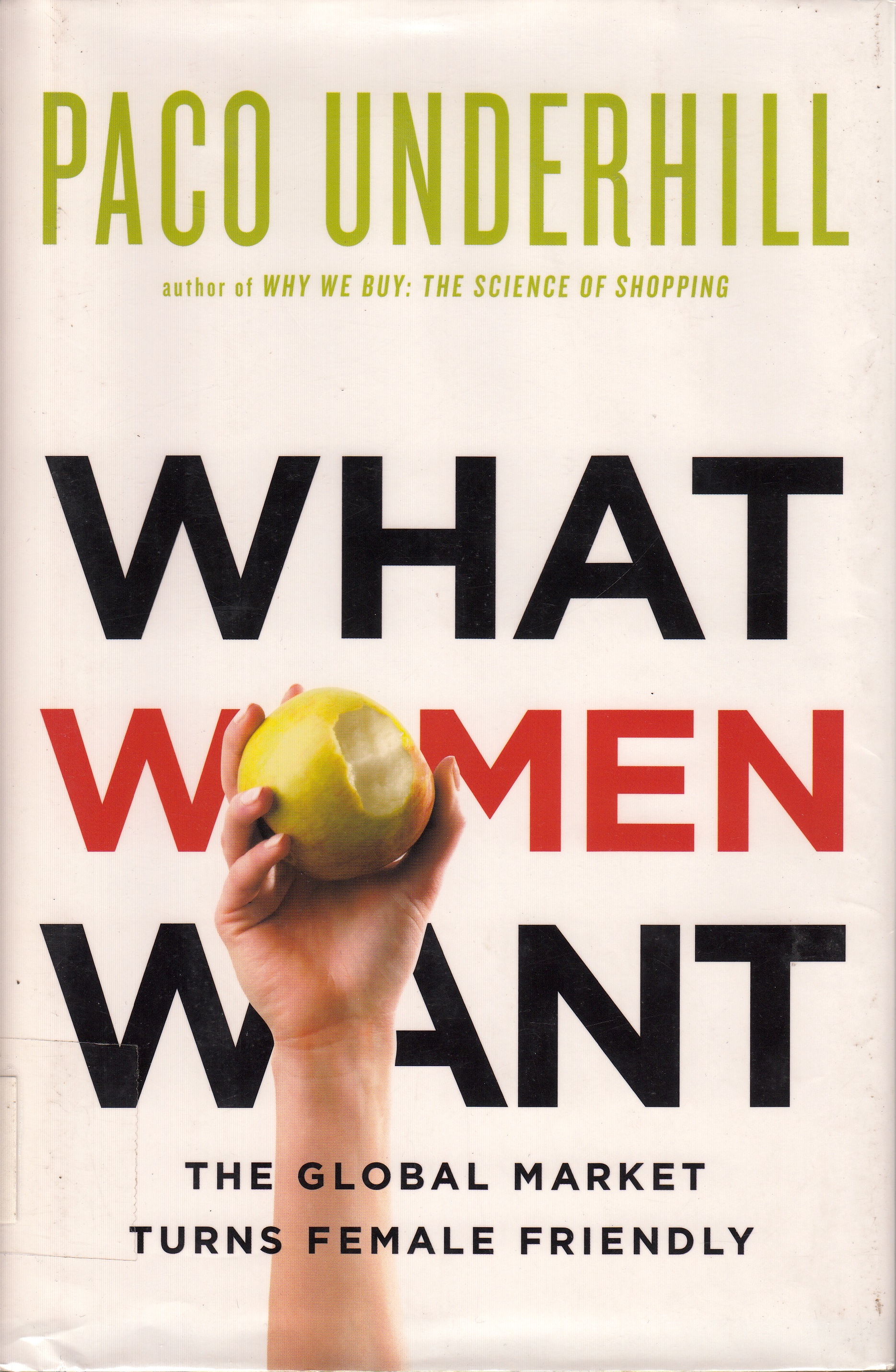
Paco Underhill is a relatively famous market researcher, specializing in retail. His first book, Why We Buy, came out while I was working at Amazon, and it was required reading for awhile. What Women Want is about the growing buying power of women, as more women earn their own money throughout the world. He covers some things that are more important to women than men (cleanliness, safety) and how stores and hotels put those concepts into play. He’s also good at backing up what he says with data.

Why should you read it?
Paco Underhill has a successful market research business, and he’s conducted market research all over the world. He uses both that experience and the data he can get his hands on/share to write a good story about how global brands can appeal to women. That said, I do have a couple of quibbles. The first is that the book can get a bit man-splain-y, like “here, let me sit down and tell you how you as a woman tend to think.” But the information is good, so I’d urge you to do your best to grit your teeth and get past it. The second is that he glosses over the fact that wives control most of the money – something like 85% of it – spent jointly via a marriage. He emphasizes women spending their own money, but not how women influence how men and women spend money together. That was the larger problem, to my mind. Overall, though, it’s a well-researched and -written book. I’d recommend it to anyone who is a market researcher or works in the retail world.

Time travel as a hook

river of no return


What’s it about?
The River of No Return is a novel about a lovesick time-traveler. Nick was a minor English lord who went off to fight against the Spanish. Just as he was about to be killed, he leapt forward in time to the present day. He encounters a group of people called The Guild who help people like Nick. He establishes himself as a landlord in Vermont, when the Guild asks him to go back in time to England. He re-falls in love with his neighbor Julia, who, it turns out, may be able to help forestall the end of the world.

Why should you read it?
If it hadn’t been my book for book club this month, I’m not sure I would have. It was a fine book, but nothing to write home about.  It does set up a sequel, so I have my usual issues with it not being a complete story. Otherwise, eh?

Closure

just one year


What’s it about?
Just One Year is the sequel to Just One Day. It picks up the story after the boy leaves the girl in Paris (with a good explanation – he’s gone out to get breakfast and is severely beaten by skinheads on the way) from the boy’s point of view. He figures out who he is over the year, looking for her and becoming more responsible and less spoiled.

Why should you read it?
Completion or closure or whatever you want to call it. I don’t know that it’s necessary, and I have issues with the whole we-grow-closer-even-though-we’re-apart theme. But it’s a nice balance to the first book, and the abrupt ending to Just One Day is a bit more satisfying with this half of the story added in.