Maybe don’t read famous books, self

Balzac and the little chinese seamstress

Imagine that it’s the Cultural Revolution, and your parents were intellectuals. You get sent off to be “re-educated”, which just means doing the menial labor no one else wants to do. It’s a small town, with no technology, no entertainment. Just work. You and your fellow male re-educate-ee discover two things: a pretty girl and a book by Balzac. What happens? What would you do to make your lives a little more enjoyable?

That’s the premise of Balzac and the Little Chinese Seamstress. It has been highly praised, and it was a fine book. My expectations, however, were too high. It was not as good as promised. I didn’t feel the weight of carrying buckets of shit up mountains each day, and I didn’t feel the relief of the occasional happy moment. I understand that a) menial labor sucks and b) getting a chance to relax after back-breaking work is a wonderful, wonderful feeling.

It’s a perfectly fine book. But I was expecting more.

Eh?

100 year old man

The 100-Year-Old Man who Climbed out the Window and Disappeared should have been a fun read. It’s whimsical; there’s a quest, which I always enjoy; there’s a bit of magical realism to it all; there’s a fair bit about 20th century history. But it wasn’t.

I’m not sure why, honestly. It might have been too whimsical and farfetched. It might have needed to go further into the magical realism of it all. Maybe it was trying to be One Hundred Years of Solitude and failing miserably? I don’t know.

Anyway, I set it down after awhile and didn’t care to pick it back up. Sometimes books are like that.

Women being friends during wartime

Rose Under Fire

Rose Under Fire, ultimately, is about female friendship. It starts with a group of young women pilots in WWII* in Britain and how they support each other through war times. One of the pilots, Rose, is captured during a run to France. The second bit of the book is about Ravensbruck, a concentration camp where women were held, and the group of friends she finds there, and how they all support each other through an absolutely horrible experience. And then the third part is about how Rose re-integrates herself back into the world, with the help of her family and friends. Their care for and love of each other comes through throughout the book.

This is a sequel of sorts to Code Name Verity, which was excellent. It’s tempting to say it’s not quite as good, but really, it’s just different. Rose Under Fire is equally as moving and captivating.

* This podcast about WASPs will enlighten you more about women pilots serving during WWII. It’s fascinating.

Blonde and wealthy is a character description, not a basis for friendship

The After Party

Sometimes, writing one of these little reviews changes how I felt about a book. I found Hild even more intellectually interesting. Writing this, though, made me dislike the book even more.

The After Party would like us to believe that Joan and Cece are friends, despite us never really seeing what the connection is between them. There are friend-like moments, but Cece mainly worships Joan. It’s unclear why – the fact that Joan is blonde and wealthy isn’t a reason. These are two people who move in the same social circles and have their entire lives. They are “friends” because of propinquity. There is no real connection between the two.

(And let’s not get started on Joan “wanting more out of life” which ends up meaning… well, spoilers. But it’s not satisfying at all, and I actually didn’t find it to be “more.” It was just different.)

In short: I just couldn’t with this book.

The definition of a summer read

Last call at the nightshade lounge

Last Call at the Nightshade Lounge is a ridiculous book. Demon-fighting bartenders who get superpowers from perfectly mixed drinks? Ridiculous. A Long Island iced tea being the perfect drink the give you maximum superpowers (and possibly immortality)? Ridiculous. A young woman’s parents, after pushing her to get a “real job” after she graduates from college suddenly being ok with her decision to be a bartender (they don’t know about the demon fighting)? Ridiculous.

I loved it.

It doesn’t take itself seriously, it’s fun, it reads relatively fast. It’s a great summer poolside read.

Intellectually interesting

Hild

Hild is a fictional account exploring how St Hilda became a saint in the first place. What was her life like? What was it like to live in 8th/9th century Britain?

Intellectually, it’s a good book. But I never really lost myself in its world. Part of it was that I had some problems with the place/person names (early English is CRAZY).

The main thing I had problems getting over though, was this. This is a book about a child – it starts when she is about 4 and ends when she gets married. Hild never acts as a child, except perhaps in the very first scene. She’s always thinking politically, plotting and gathering information. Her judgement is unfailingly correct, and she is wise beyond her years.

Look: different time, different place. She and her mother are both ambitious and their positions at court are precarious. Lives were shorter, people had more responsibility earlier, and you had to grow up faster. But she is still a child.

Hild is a near-perfect person from a very early age. It isn’t so much about her becoming a saint as it is showing the otherworldliness of someone who already is a saint.

Which makes it different than most fiction (at least that I usually read) about people making mistakes and figuring out who they are. She already knows.

A life lived in a dream

The Orchardist

The Orchardist is a lovely story about a man, Talmadge, who runs/owns an apple orchard in central Washington in the late 1800s – early 1900s. It describes a quiet, isolated life that is disrupted when two girls come into the valley. They’re pregnant and they’ve run away from some truly horrible circumstances. The Orchardist describes what happens over the next twenty years in a way that illuminates loneliness, the solitary life, and the weirdness of families. Recommended.

Making a life for onesself

The Language of Flowers

What’s it about?
Victoria is a mess. She’s grown up in the foster care system, and she’s just turned 18, which means that there’s no one responsible for her any more. And she certainly hasn’t mastered the basics of finding food and shelter, let alone having a life. But she does like flowers and what they mean. This is the story of how she pieces a life together.

Why should you read it?
You’ll need to make it past the first chapter of The Language of Flowers, which I found slightly cringe-worthy. Maybe I was supposed to – after all, she isn’t a good person at first and her life is pretty terrible. There’s not a lot to like there.

But after that, once you get into her relationships with other people, with her desire to be a florist, with her relationships with Grant and Elizabeth and the family she’s fallen into in San Francisco, it’s good. I like a story where someone turns their life around, and not into a typical life. You can be successful without being a stereotype.

High Society

China Rich Girlfriend

What’s it about?
Did you read Crazy Rich Asians? China Rich Girlfriend is its sequel. We met Nick’s family in the first book, and this time we meet Rachel’s. She discovers her birth father (she was raised by a single mother in Cupertino – just down the street!), and it turns out that he’s one of the new Chinese billionaires. Which allows our author to explore Shanghai society in this book like he explored Singapore society in the last one.

I should note that Rachel is not the China Rich Girlfriend. She discovers she has a half-brother; his girlfriend is the titular character.

Why should you read it?
You should read it because you read and enjoyed the first book. It’s not as good, but it is still fun. Kevin Kwan – the author – was raised in Singapore and clearly has first-hand experience of a lot of that city; he researched Shanghai.

But overall China Rich Girlfriend is a relaxing beach/vacation/holiday read. (I’m not saying much, but there’s not a huge amount to say – which isn’t always a bad thing. Sometimes an entertaining fun read is all you want.)

Because Judy Blume

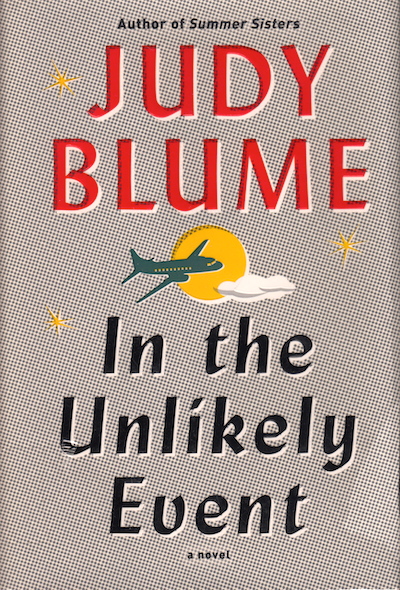
In the unlikely event

What’s it about?
Back in the 1950s, in real life, there was a New Jersey town where three planes crashed in a calendar year. Judy Blume grew up in that town. In the Unlikely Event is the story that captures what it was like to live there and the paranoia that takes over with a series of unusual events like that.

Why should you read it?
Because Judy Blume. I’m not going to lie. That was one of my major reasons.

She uses a very not-traditionally-Judy-Blume narrative trick: she changes perspectives. A lot. There are a ton of characters in this story, both main and minor. Parts of the story are told from each other their points of view. It can be hard to keep track of, particularly at first. (I’ve had many conversations with friends about this book – we all talk about this.) As soon as I stopped trying to figure out who I needed to care about and why for every single character switch, it got a lot easier to figure out which characters were important and why. Allowing myself the ambiguity at first made for a much better reading experience. It all worked out in the end.

Is it one of her best books? Probably not. Did I care? Not really. It was still entertaining and satisfied my curiosity.